Address
7 Temasek Boulevard, #12-07 Suntec Tower One, Singapore 038987
Work Hours
Monday to Friday: 9am – 6pm
Weekend: 9am – 1pm
Address
7 Temasek Boulevard, #12-07 Suntec Tower One, Singapore 038987
Work Hours
Monday to Friday: 9am – 6pm
Weekend: 9am – 1pm
Today, the corporate office remains a tough workplace environment to organise and harmonize as systems and requirements are evolving. Overall, the modern corporate workplace faces immense challenges in harmonizing evolving systems, necessitating a robust enterprise approach to organize and optimize the way we work.
This article proposes the implementation of an Enterprise Artificial Intelligence (EAI) Enabled Corporate 4.0 Workplace System, which functions as an operational “Digital Twin” to ensure seamless interoperability and near real-time demand response across all layers.
An AI project is an isolated experiment focused on building a model for a specific task, while enterprise AI is an integrated, secure, and scalable operational system aligned with core business strategy.
– AI Projects is localized, short-term experiments that test specific capabilities, and Enterprise AI as a secure, company-wide infrastructure that scales value and manages risk.
– While a standard AI project often succeeds when a model hits an accuracy target in a sandbox, enterprise AI succeeds only when it transforms live business operations, handles probabilistic risks, and delivers measurable return on investment (ROI).
An ideal AI adoption journey transitions an organization from isolated AI Projects (experimental, proof-of-concept tools) to Enterprise AI (scalable, integrated, and governed capabilities across the entire business).
The journey moves through four distinct phases:
Phase 1 – Exploration and Ideation (AI Projects): Identify high-value business problems and test technical feasibility.
Phase 2 – Operationalization and Scaling: Move successful pilots out of the sandbox and into production environments.
Phase 3: Enterprise Integration and Governance (Enterprise AI): Unify AI efforts under a centralized strategy with decentralized execution.
Phase 4: Transformation and Continuous Innovation: Make AI a core driver of business strategy and new revenue streams.
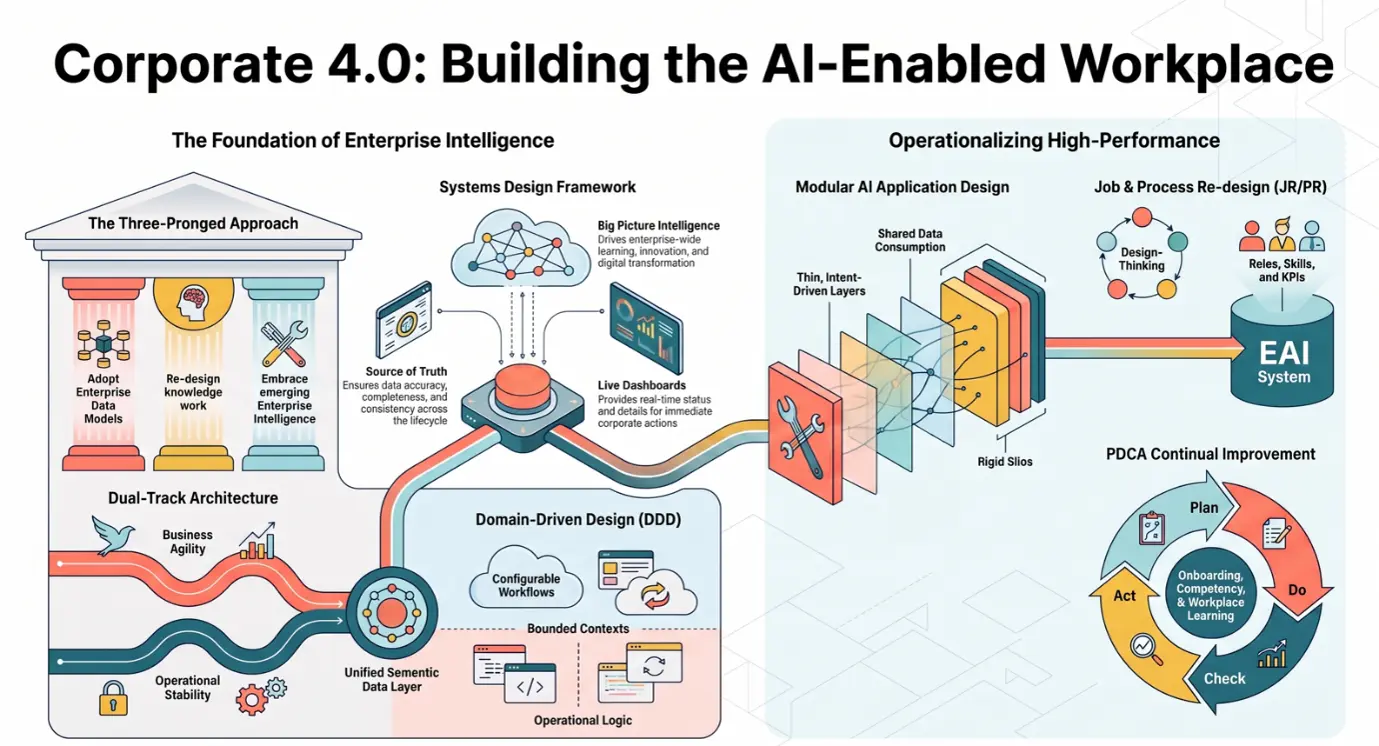
Conceptually, we need a One-Stop Enterprise Artificial Intelligence (EAI) Enabled Corporate4.0 Workplace Systems to strategise and manage the evolving enterprise data and knowledge from the corporate perspective.
All shall be aligned to business based on Domain-Driven Design (DDD) Boundaries, which clearly separate bounded contexts so that operational hard-coded logic and configurable workflow layers are distinctly separated.
A three-pronged integrative and practical approach is proposed as follows:
a. Adopt Enterprise Data Models (EDM) to maintain and organise top-level view of the Structured Data, which cut across various systems and adhoc databases and spreadsheets.
b. Re-design the existing knowledge work, including forms, templates, methods, procedures, and workflow into Enterprise Knowledge Models (EKM). This is a constant effort and pursuit to structure the unstructured data within and across the departments.
c. Embrace the emerging Enterprise Intelligence (EI) solutions and extend the enterprise knowledge graph models to support add-on Artificial Intelligence (AI) solutions to further organise the vast untapped Unstructured Data.
The Corporate4.0 Enterprise Intelligence System of Systems is the unified enterprise Data and Knowledge Infrastructure that sits above existing data and software stacks to unify data, business knowledge, and process logic into a single, governed system for AI agents. We also propose to adopt an Enterprise Design Thinking (EDT) approach to re-imagine and re-design based on the following Systems Design:
We shall embrace Enterprise Intelligence with AI for Corporate Learning, Innovation and Transformation.
An Enterprise Intelligence architecture using a dual-track strategy is a recommended approach for balancing operational stability with business agility, provided you enforce strict data contracts and domain-driven boundaries.
The 360° Enterprise Intelligence Layer acts as the nervous system connecting both tracks via an event-driven mesh and a unified semantic layer (data fabric/ontology).
Designing an AI application to ride on an enterprise intelligence platform requires shifting from rigid, process-driven design to a modular, intent-and-decision-driven architecture. Rather than building isolated vertical silos, applications must act as thin, composable experience layers that consume unified enterprise data, shared models, and governance frameworks from the underlying platform. Key Design Approaches
Data integrity is the overall accuracy, completeness, and consistency of data across its entire lifecycle. Its core types are physical integrity and logical integrity. The types of data integrity are as follows:
Systems interoperability is the ability of different software applications, hardware, and information networks to communicate, exchange, and use data seamlessly without manual effort. We shall look closely into API Gateways, enforcing key API designs to manage interoperability and backward compatibility between tracks.
Key Layers of Interoperability builds across four progressive layers:
The modern enterprise intelligence systems shall be a flexible and configurable platform (no-code or less-code) to empower the new breed of business systems architect to manage and bend all systems and processes into one system of systems to enable the followings:
To realise the Enterprise Artificial Intelligence (EAI) Workplace Systems, we will need the key stakeholders to evolve and embrace a shared vision, new skillsets and mindsets. To this end, we envisage an extensive and continual Job Re-design and Process Re-design (JR/PR) exercise enabled by Corporate4.0 Enterprise Design Thinking:
– Current State & Pain-Points – Quick Assessment
– SOP-Centric Capability & QA Requirements
– Enterprise Design Thinking – Process-Innovation, Technology, EAI & Corporate4.0
– Team-Job-Roles & Sub-Roles
– Policy-SOP-4W1H
– Data-Flow to Reporting to Dashboard
– Role-Skills Mapping
– Role-KPI Mapping
– Workplace Learning – Onboarding, OJT, Competency
– PDCA (Pan-Do-Check-Act) Continual Improvement
As we understand, it is transformation roadmap that require strategic action plan that sequences change initiatives, dependencies, and milestones over time to bridge the gap between high-level business strategy and day-to-day execution. The core phases of a transformation roadmap are crucial for guiding organizations through their digital transformation journey.
These phases include:
The successful transition to an Enterprise AI-Enabled Corporate 4.0 Workplace relies on shifting from rigid silos to a modular, intent-driven "system of systems" that effectively bridges the gap between strategic vision and daily execution. By integrating Domain-Driven Design and a dual-track architecture, organizations can maintain operational stability while achieving the agility necessary for near real-time demand response. This transformation is realized through the development of High-Performing Teams and a continuous commitment to job and process re-design, ensuring that human expertise evolves alongside technological capabilities. Ultimately, by prioritizing data integrity and interoperability, the Corporate 4.0 ecosystem creates a sustainable foundation for innovation, productivity, and knowledge continuity in the modern workplace.

About the Author: Ng Kok Chuan (KC) is the Chief Education Consultant and Managing Director of Xi3 Consulting Pte Ltd, which offers Edu-Tech consulting services from courseware, to software and “heart-ware” for business, systems and job re-design, for change and transformation. Xi3 Consulting Pte Ltd offers set-up, registration, and Merger and Acquisition (M&S) and due diligence service for private education institutions in Singapore.
